Published standards for every product family
Every item in the catalogue is defined by its standard, size, wall thickness and weight. The tables below are taken from the factory's official catalogue and are updated whenever a new edition is issued.
What are our products made and tested to?
- UPVC pressure & water pipes
- ASTM D1785 (Schedule 40 / 80) · ASTM D2241 (SDR) · DIN 8062 / ISO 4422 · BS 3506 (Class B, C, O) · SASO 14-15 equivalent to DIN 8061/8062 (Class 2–5: 4 / 6 / 10 / 16 bar)
- Electrical conduit
- NEMA TC-2 (EPC-40 / EPC-80) · ANSI/UL 651 · NEMA TC-6 & TC-8 for encased and direct burial (EB / DB)
- Electrical fittings & couplings
- NEMA TC-3 for rigid conduit fittings · NEMA TC-9 for underground conduit fittings
- Electrical conduit to European standards
- IEC / EN 61386 (formerly BS 6099) — duty grades: Light Duty 2221 · Medium Duty 3321 · Heavy Duty 4421 · Extra Heavy Duty 5521, within a temperature range of −5 to 60 °C
From the official catalogue — one page per piping system
Click any table to open it at full size. The values (outside diameter, wall thickness, weight per metre, working pressure) are those of the applicable standard.
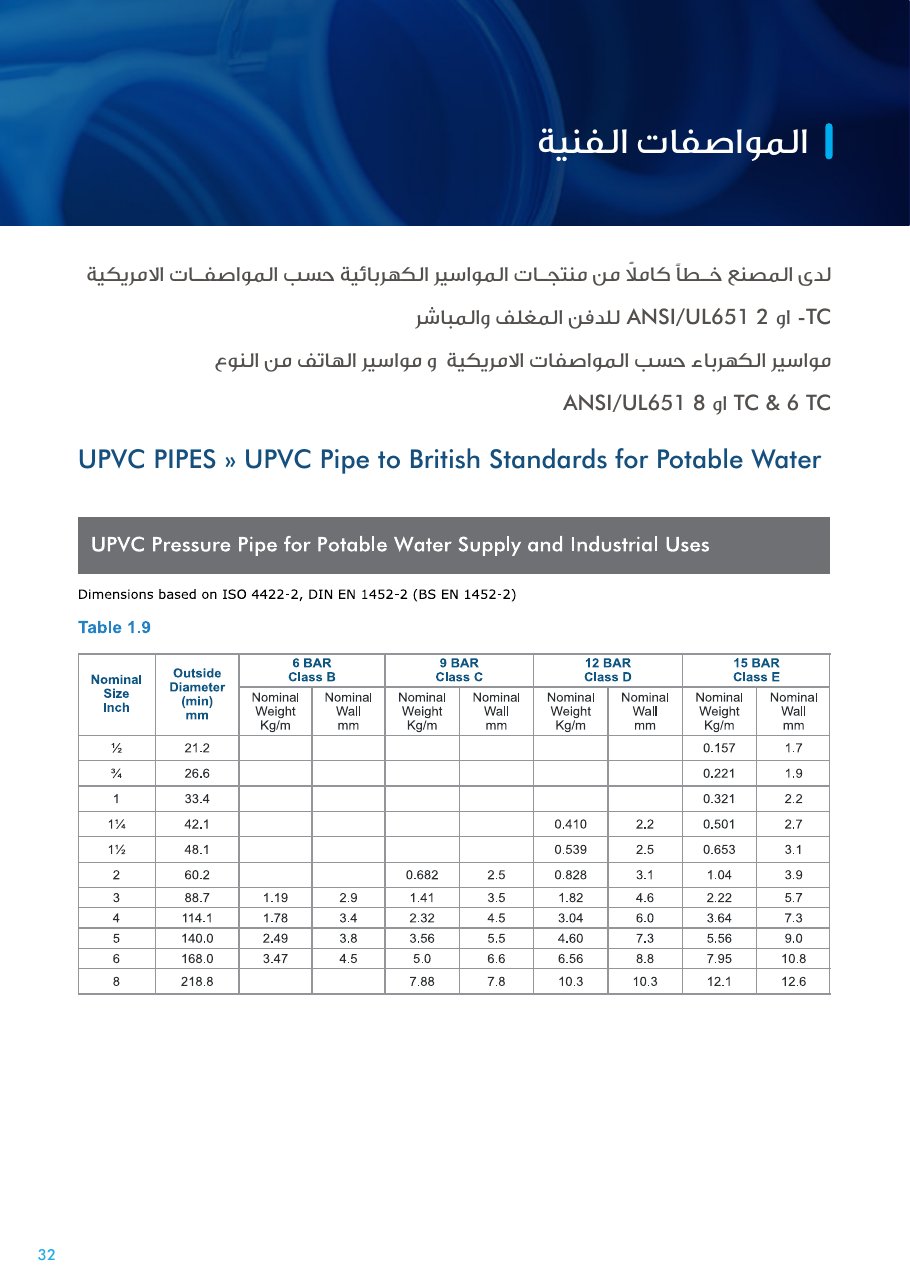
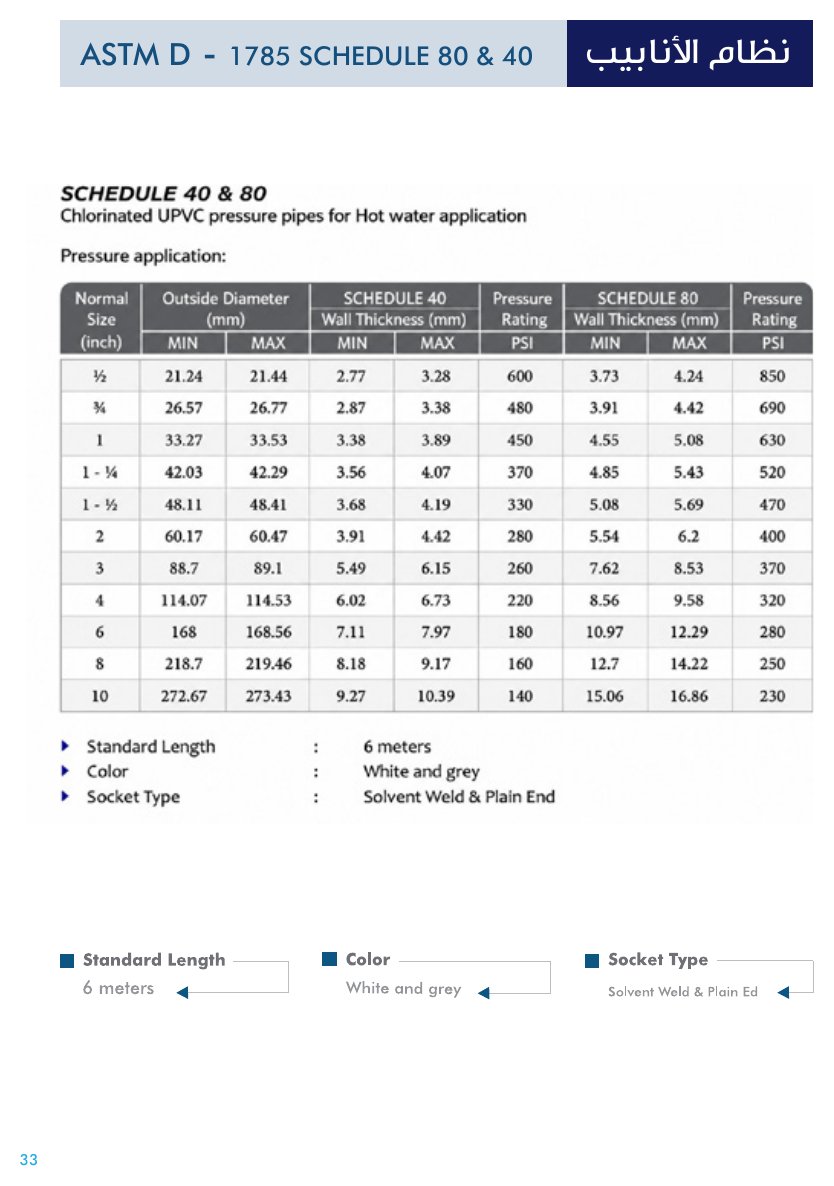
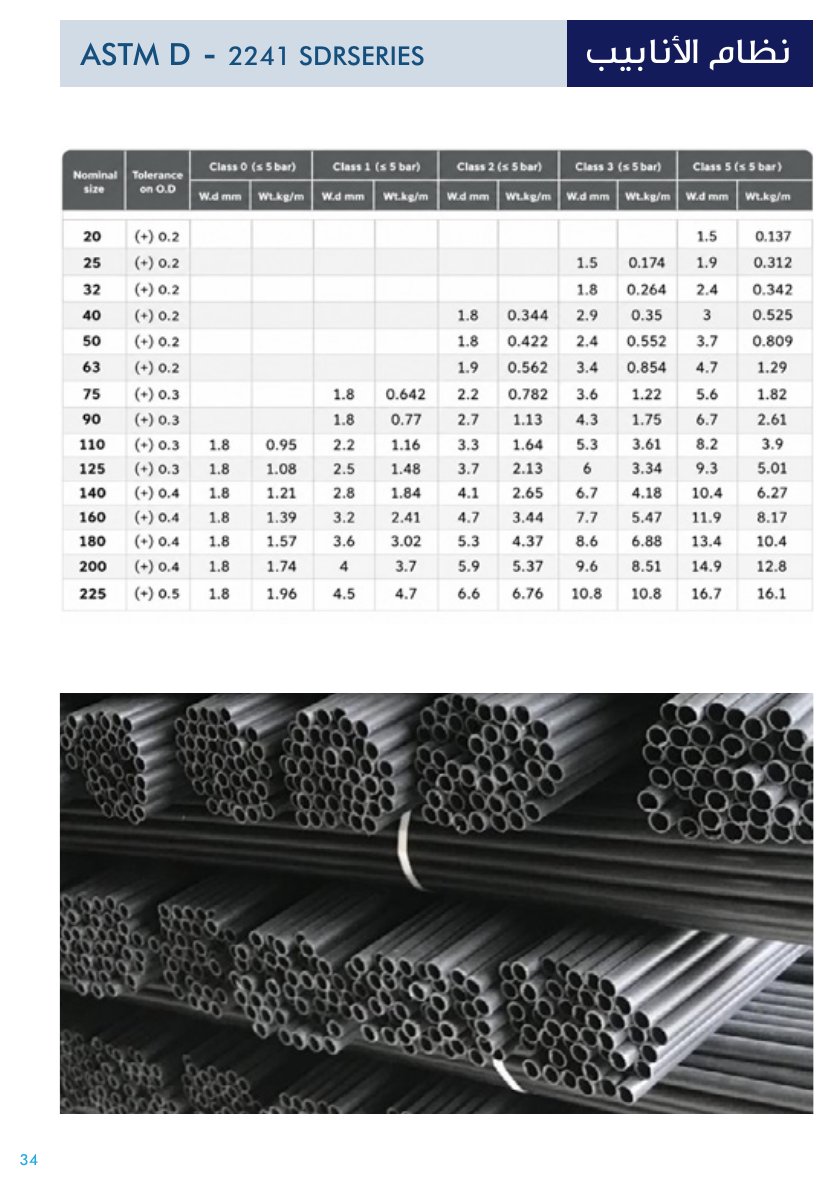
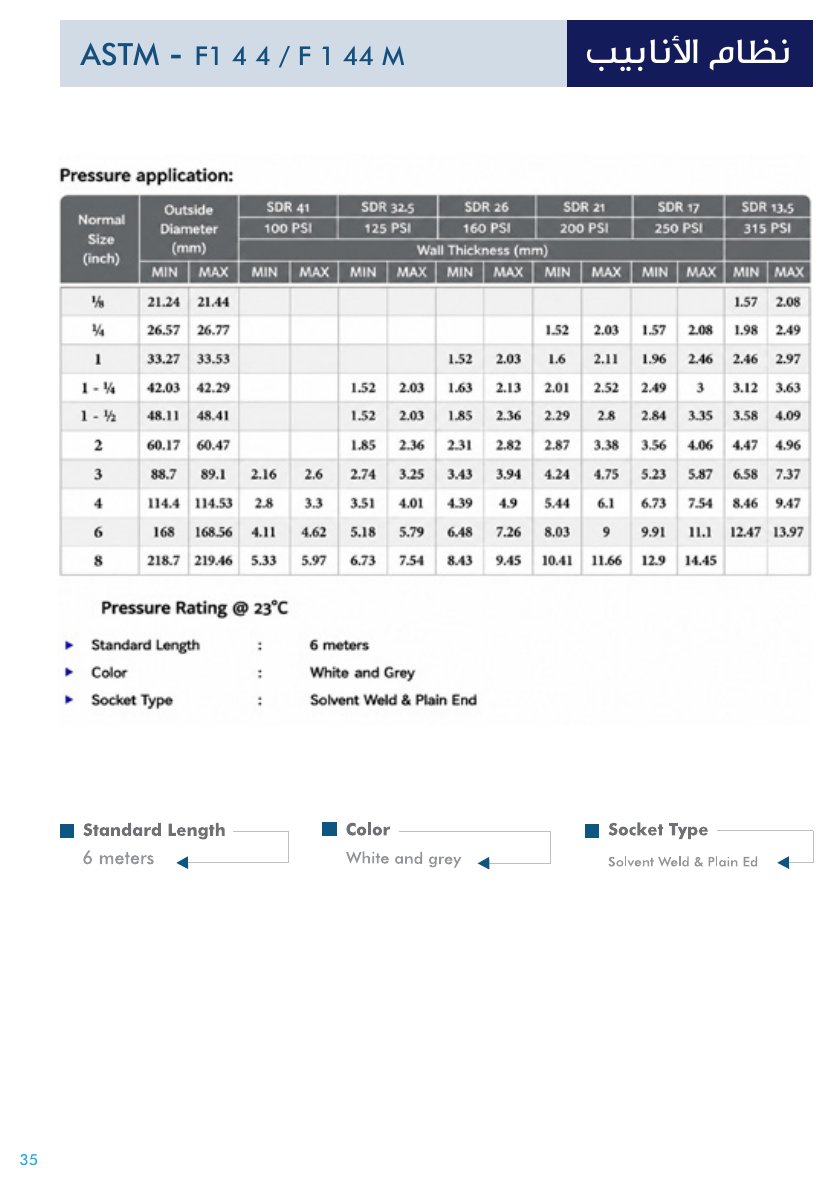
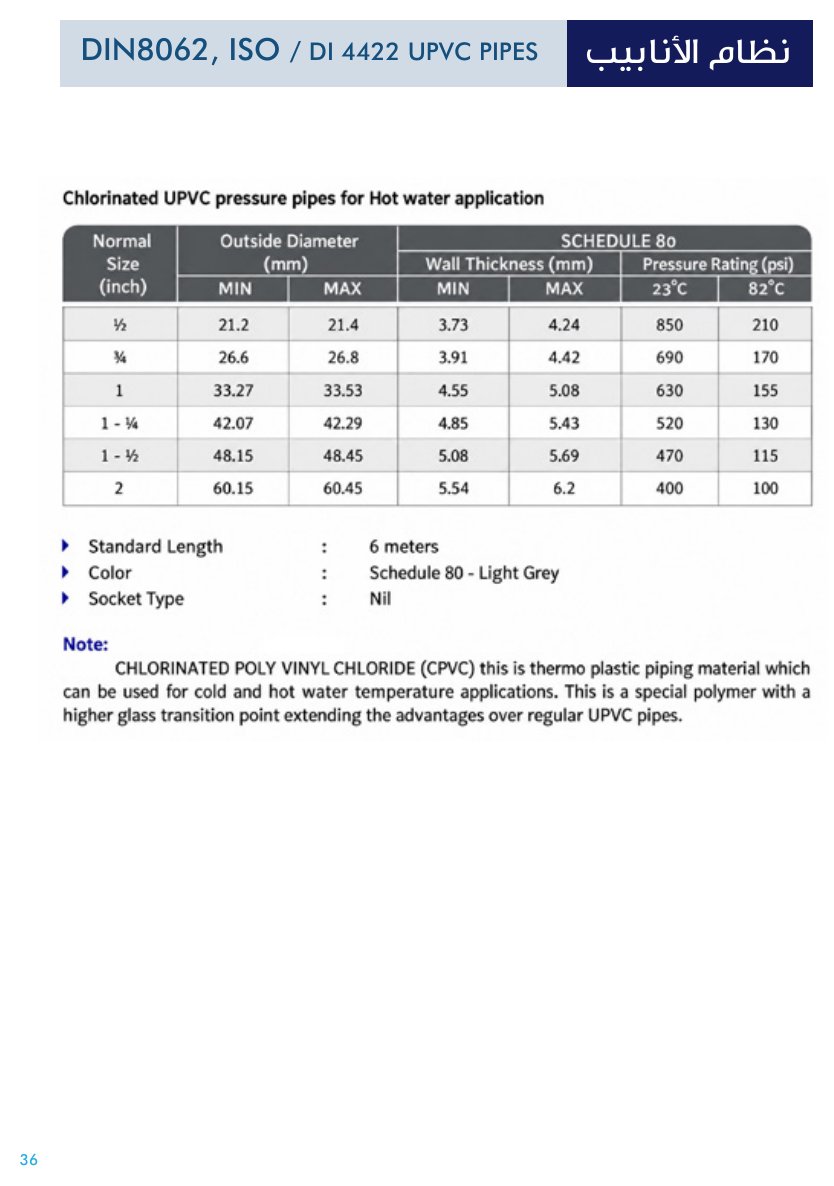
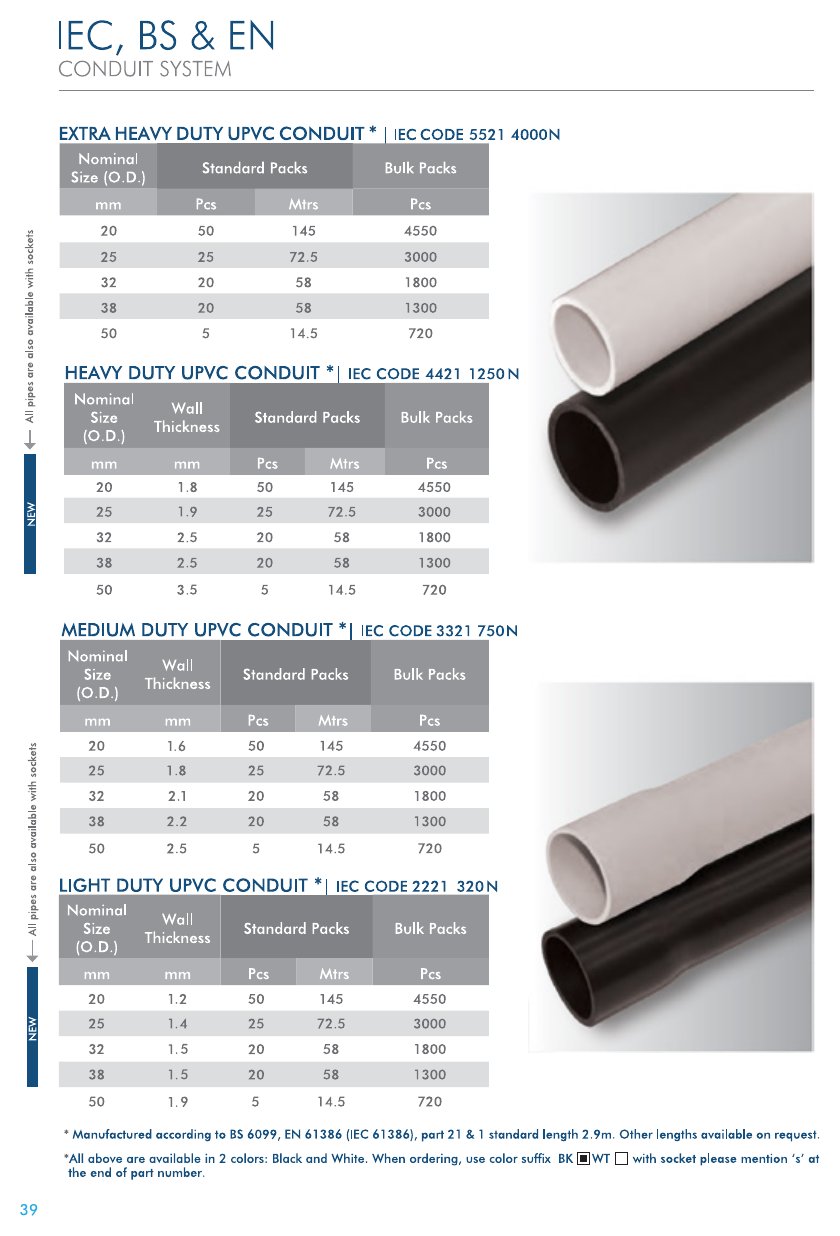
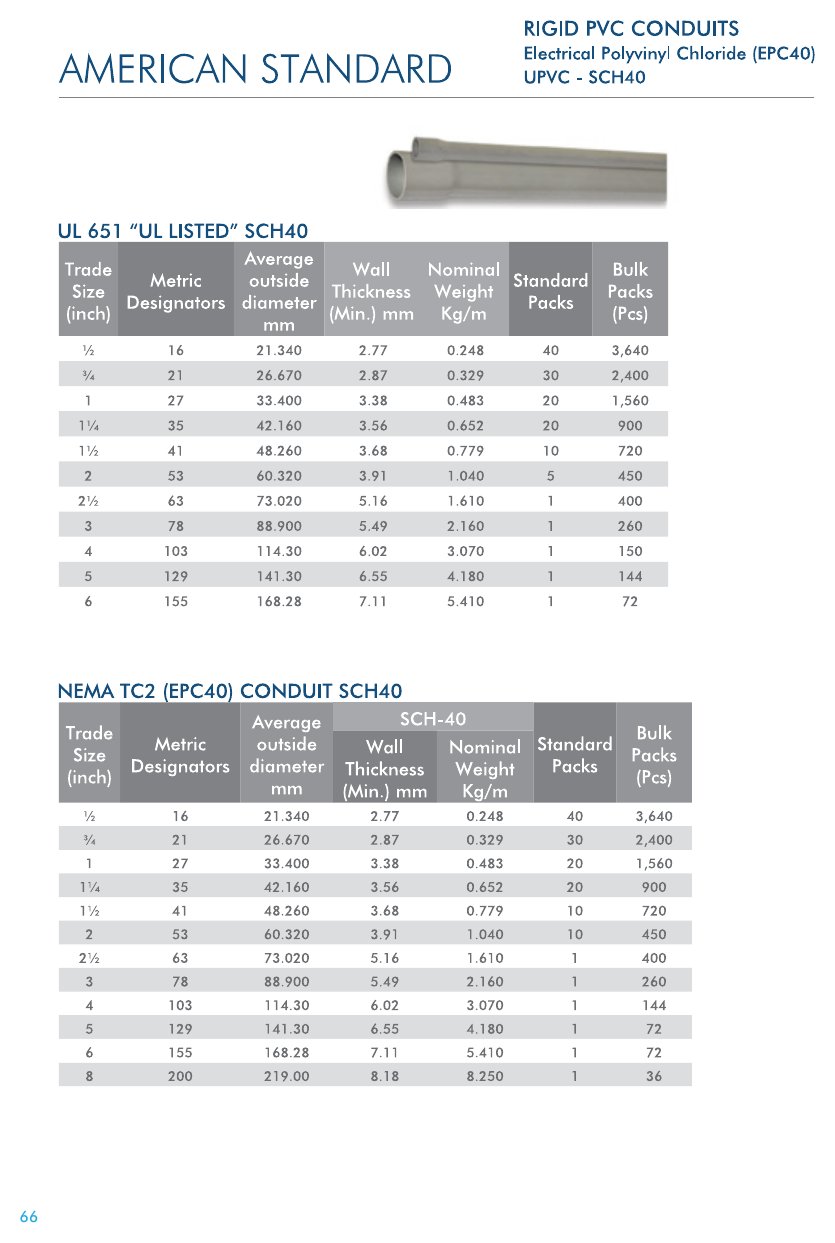
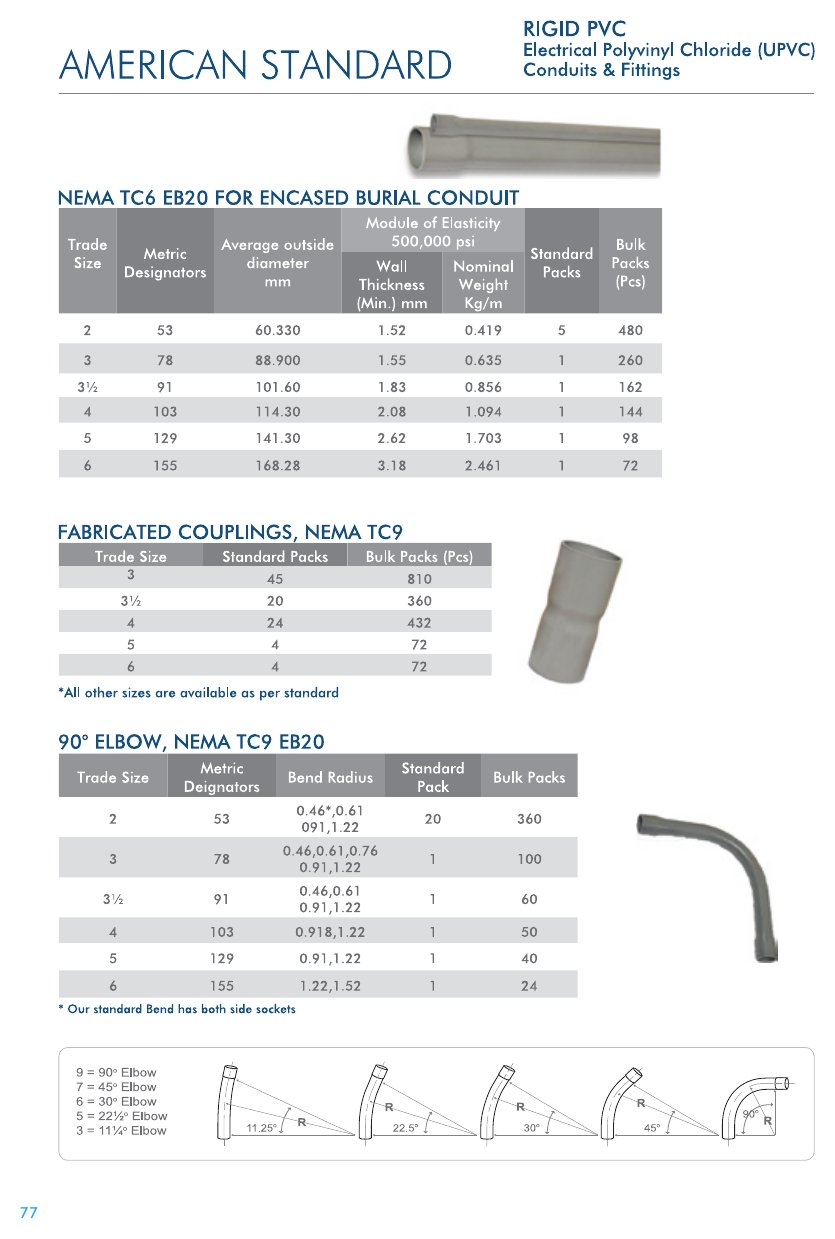
The full catalogue (90 pages) includes the fittings, couplings and accessories tables for every standard — catalogue page.
How do we ensure every batch conforms?
- On the production line
- Outside diameter, wall thickness and length are monitored on every batch according to the standard applicable to the item.
- Before shipping
- Pipes are selected according to the standard and the intended use, and a tag is attached to every bundle confirming the product passed its tests.
- Management systems
- The factory holds ISO 9001:2015 (quality management) and ISO 45001:2018 (occupational health and safety); renewed copies are published on the Registrations & Credentials page as soon as they are received.
- Specification sheets per item
- Added to the item page when provided by the factory. Until then, the catalogue is the approved technical reference.
Protecting the product starts the moment it is received
Transport from the factory
Pipes are bundled in a timber frame and stacked alternately head-to-tail for easy loading. The number of pipes per bundle depends on the diameter, per the standard's tables. On site, pipes are not tipped off directly but unloaded by crane or alternately, and the spigot ends are supported on timber blocks no more than two metres apart to avoid bending.
Handling on site
Avoid impacts and direct sunlight, and do not leave pipes on the trench edge for long. Because of their weight, take care when lifting or lowering by hand, make sure the loading area is free of nails or sharp edges, and preferably use timber boards as protective bases. Keep the jointing rings carefully.
Long-term storage
In a warehouse or under a shade away from direct sunlight, on level ground or timber blocks, stacked alternately layer by layer, with the stack height between supports not exceeding five metres.
Installation per the Saudi Building Code
Follow the design and installation instructions for water, drinking-water and sewer pipelines, and the project consultant's instructions on soil type, laying depth and bedding above and below the pipe. Before installation, clean the rubber ring and the pipe thoroughly, make sure the spigot enters the socket and the two pipes are aligned, and use the dedicated pipe-jointing lubricant.
Warranty details and test procedures are confirmed by the factory in the official quotation for each project.
Need a specific standard for your project?
Send the items, quantities and delivery city, and the sales team will return with an official quotation.